
Wise County Projected Versus Actual Release
A projected release date is an agency's current working calculation. For a person in TDCJ custody, the projection reflects the sentence, applicable credits, eligibility rules, and other case facts in the state record. TDCJ defines the projected date as the date expected if the prisoner is not paroled sooner. It is not a court promise. When release is arranged, the public detail may instead show a scheduled release date and location.
Actual release is the completed custody event. A person can reach a projected or scheduled date and remain confined due to a detainer, warrant, required program, approved-plan problem, medical issue, or processing change. A transfer out of Bridgeport Unit also does not prove release from TDCJ. It may be an internal move to another state unit.
Scheduled versus actual: Treat every projected or scheduled date as provisional until TDCJ or Wise County records show the completed release event.
County jail dates work differently. A pretrial detainee has no sentence-based release projection. Bond can authorize release, but the person must still clear all holds. A person serving a county sentence may have a calculated discharge date based on the judgment, jail credit, sentence structure, and any lawful local credit. The Sheriff calculation, not a TDCJ formula, controls that county sentence.
Find Wise County Projected Release Dates
Choose the source by custody type. The TDCJ Inmate Information Search covers people currently incarcerated in a TDCJ facility. Search by a seven-digit TDCJ number or SID when possible. Otherwise, use the exact last name, at least a first initial, and gender or race only to separate likely matches. The data are at least 24 hours old and update on working days.
Open the matching detail and record each label as shown. Useful fields can include current unit, offense and county, maximum sentence date, projected release date, and Parole Review Information. Once TDCJ schedules release, a scheduled date and location may appear. Former prisoners usually do not remain as a released or discharged result in this current-only search.
- Identify whether the person is in the Wise County Detention Center, Bridgeport Unit or another TDCJ unit, or another custody system.
- For current state custody, search by TDCJ number or SID and open the exact matching detail.
- Copy the projected, scheduled, maximum, and parole labels separately, with the date accessed.
- For a Wise County sentence, obtain the signed judgment and request the jail time sheet or calculation.
- For a pretrial case, check bond and court orders, then verify that all holds cleared before treating the person as released.
- After the event, confirm the actual out-book or TDCJ release history rather than relying on the earlier projection.
The Wise County released inmate search explains how to pair a local jail movement record with the court disposition. That two-source check matters because Odyssey separates Jail Records, Jail Bond Records, and criminal case records. Each describes a different part of the process.
Note: A bond amount or posted bond can authorize release, but it does not prove that every warrant or detainer cleared.
Texas Time Rules for Wise County
Texas does not impose a general rule that every prisoner must serve 85 percent of a sentence. Offense, offense date, sentence structure, good-time class, mandatory-supervision eligibility, Board action, consecutive terms, detainers, and forfeitures can all matter. Applying a simple percentage to a Wise County sentence can produce a false date.
Under Government Code Section 498.003, good-conduct time is a privilege tied to classification and participation. It affects parole or mandatory-supervision eligibility. It does not shorten the sentence itself, and discipline can reduce or forfeit credit. That is why the TDCJ projected date is the working state calculation.
For many ordinary parole cases, Government Code Section 508.145(f) allows eligibility when calendar time plus accrued good time equals one-fourth of the sentence or 15 years, whichever is less, subject to special rules. Eligibility only means the Board may consider release. It is not a release grant. For the offense group tied to Code of Criminal Procedure article 42A.054 and the applicable Section 508.145 subsections, calendar-time rules are stricter and good time may not count toward the eligibility threshold.
The official Government Code Chapter 508 text sets parole eligibility and mandatory-supervision exclusions. Its source image shows why Sections 508.145 and 508.149 must be read with the exact offense and offense date.
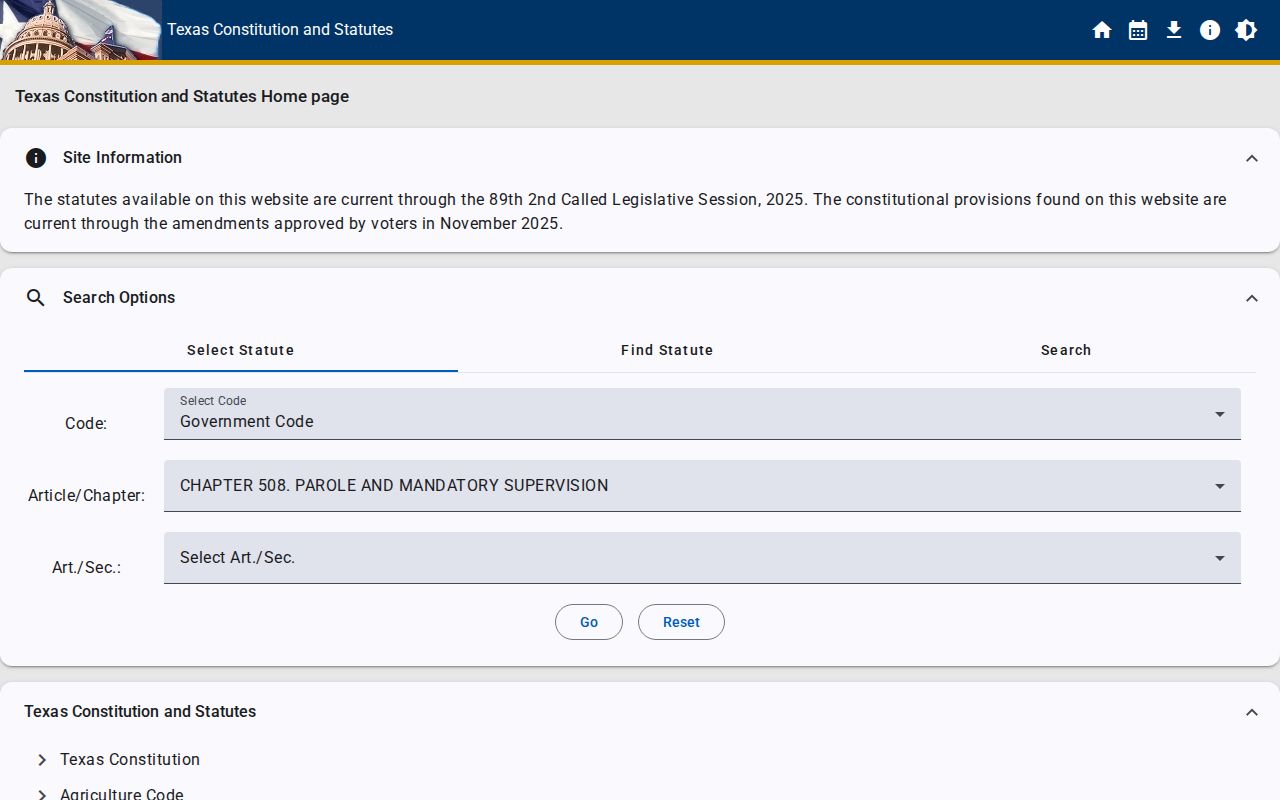
The statute supports a case-specific calculation, not a countywide percentage rule or a promised release day.
Wise County Mandatory Supervision Dates
Mandatory supervision is not automatic for every state prisoner. Section 508.147 generally uses calendar time plus accrued good time reaching the maximum term, but Section 508.149(a) excludes listed offenses. Section 508.149(b) also lets a parole panel deny discretionary mandatory supervision when both statutory findings are made.
A denial can move a displayed projection toward maximum expiration. Later approval can change it again. For some cases predating September 1, 1996, older mandatory-supervision rules may affect the projection. Never transfer one person's formula to another without the offense date and controlling law.
Parole review data are another distinct set of fields. A review date, favorable vote, or eligibility date does not prove actual release. A required program or approved release plan can remain pending after a vote. For a Wise County parole destination, the supervising district office may also be outside the county.
Wise County State-Jail Credit Rules
State-jail felonies use a separate framework. TDCJ states that state-jail prisoners do not earn ordinary good-conduct time. In qualifying cases under the applicable post-2011 or post-2015 rules, the sentencing judge may award diligent-participation credit after TDCJ reports qualifying participation. The court may award some, all, or none as law permits.
The TDCJ diligent-participation page explains the state-jail process and its 80-percent reporting trigger. That trigger is not an 80-percent or 85-percent rule for release. It is part of the reporting process that precedes a possible judicial credit award.
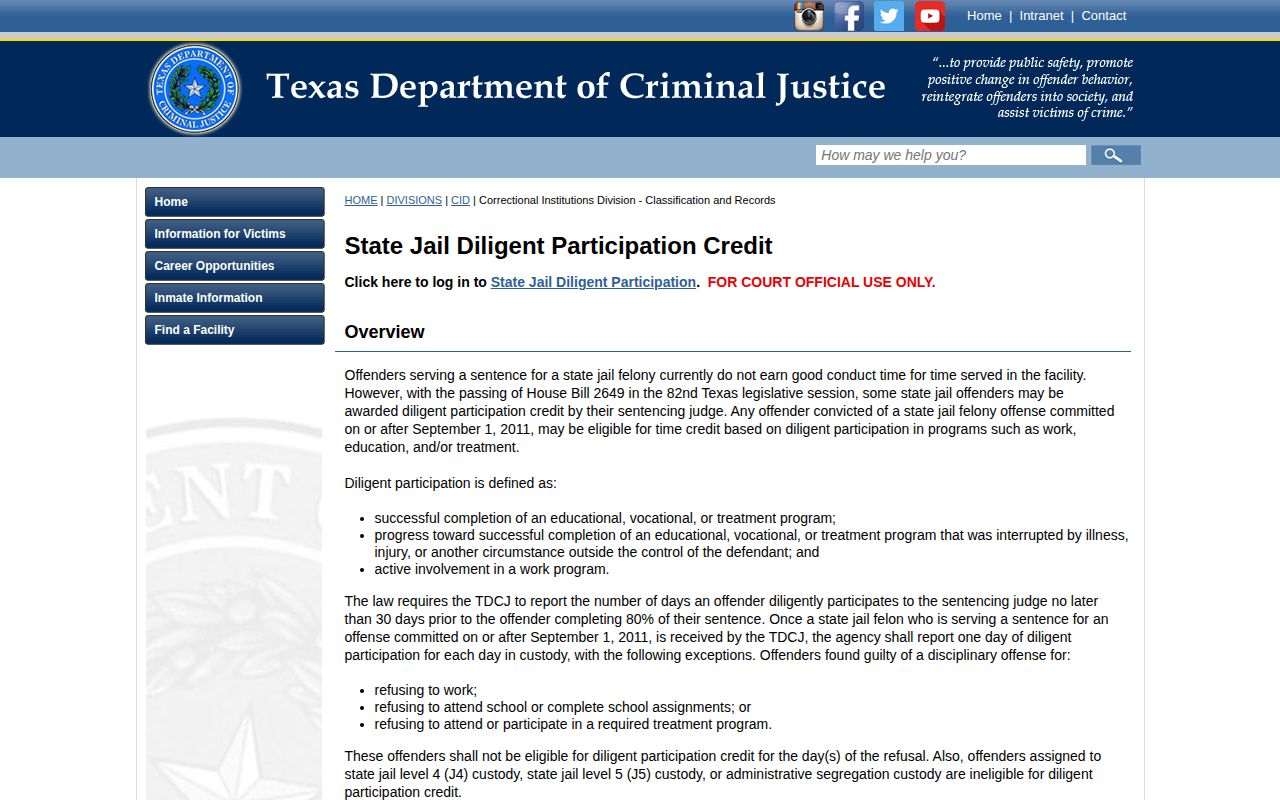
The image reinforces that the judge's decision and TDCJ report, not a rough sentence fraction, control this credit question.
Note: State-jail credit and ordinary TDCJ good time are different rules and should never be combined into one estimate.
Wise County Jail Release Calculations
A Wise County jail sentence is controlled by the signed judgment, statutory jail credit, concurrent or consecutive structure, and the Sheriff's calculation. Any applicable local good-conduct policy would also matter. No official Wise County good-time rate was found, so a daily credit rate should not be invented or copied from another county.
Request the time sheet or calculation when the exact discharge day matters. Give the full name, date of birth, booking number or cause number, and the sentence involved. Ask the Wise County Detention Center to identify the judgment used, credited days, sentence start, other holds, and calculated discharge. The public number is 940-627-5971 at 200 Rook Ramsey Drive in Decatur. No release-search hours were published.
Pretrial cases need a different inquiry. Search the criminal case and Jail Bond Records, but verify physical departure in a historical jail movement record. The Wise County Clerk criminal department generally routes county-level misdemeanor files, while the Wise County District Clerk maintains felony district records. A dismissal, acquittal, personal bond, cash or surety bond, or court directive can support release. None proves that an out-of-county warrant, TDCJ commitment, USMS transfer, or ICE hold did not continue custody.
Why Wise County Release Dates Move
A release projection is a snapshot of the facts known to the calculating agency. New legal action, credit changes, or custody holds can move the date. The direction is not always later. A corrected judgment or later Board approval can move a working date sooner, while a forfeiture or denial can move it later.
| Factor | Possible effect | Best confirmation |
|---|---|---|
| Good-time loss | Changes state eligibility or projection | TDCJ Classification and Records |
| Parole vote | May permit earlier release or set later review | TDCJ detail and Board result |
| Mandatory-supervision denial | May move projection toward maximum expiration | Board and TDCJ records |
| Detainer or warrant | Can block community release or cause transfer | Jail movement and receiving agency |
| Court correction | May alter sentence or credited time | Signed amended judgment |
| Program or release plan | Can delay a scheduled state release | TDCJ Classification or Parole Division |
| County time credit | Can alter a county sentence discharge calculation | Wise County jail time sheet |
A movement to another facility is not an earlier release. Bridgeport Unit departure may be an internal TDCJ transfer. Wise County jail departure may lead to TDCJ, another county, USMS, or ICE. The destination field resolves that ambiguity.
Confirm Wise County Actual Release
For TDCJ time questions, Classification and Records is the correct technical office: PO Box 99, Huntsville, TX 77342-0099; 936-437-6231; classify@tdcj.texas.gov. For a former prisoner's documents, request incarceration history, actual release date, release type, discharge date, and release location from TDCJ Public Information at PIA@tdcj.texas.gov or PO Box 4017, Huntsville, TX 77342.
A VINELink alert can flag a pending custody change from a participating agency, but the source agency must confirm it. The Wise County VINELink check explains how to save and verify a person-specific event. VINE does not replace a jail out-book record or TDCJ release history.
Write down the source, exact field label, access time, and identity number. Then compare the actual event with the prior projection. This method preserves the key difference: “Projected Release Date” describes a working estimate, “Scheduled Release” describes planned processing, and an actual release record documents what occurred. A later TDCJ calculation may differ after credit, discipline, a Board action, a detainer, or another custody event, so preserve the date on which each displayed value was read.